Here’s something nobody tells you about buying property in Versailles: you might accidentally purchase a piece of royal history.
We thought we were buying a run-down office space with good bones and a convenient location. Wedged between the prefecture and Monoprix, nothing about it screamed historic landmark. It just seemed like a great spot for an Airbnb.
Then our real estate agent mentioned the dogs — and everything got a lot more interesting.

Wait. The King’s What?
I’m covered in plaster dust, elbow-deep in renovation chaos, when my husband calls me over to his laptop.
“You need to see this.”
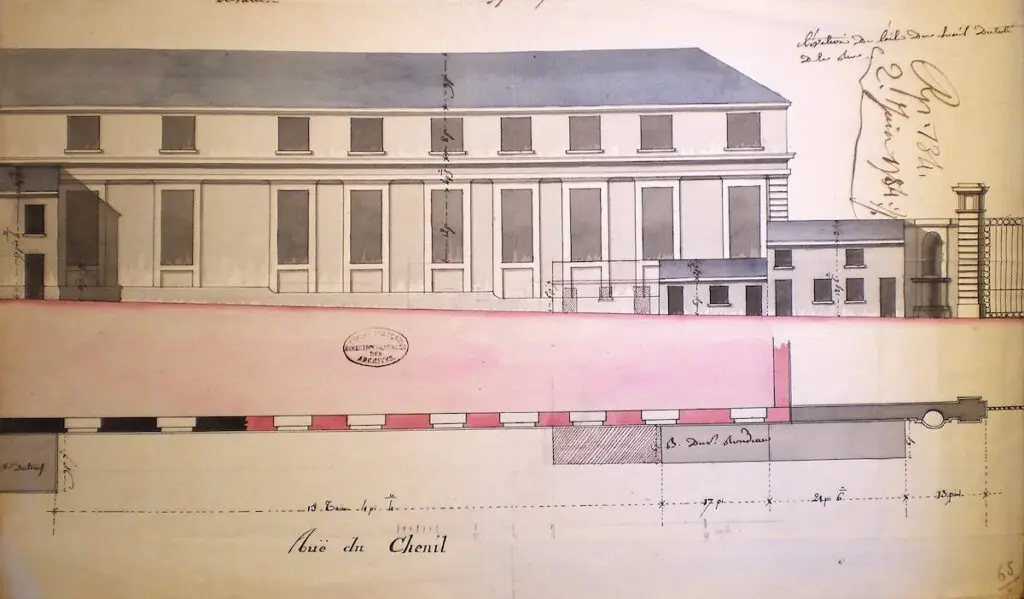
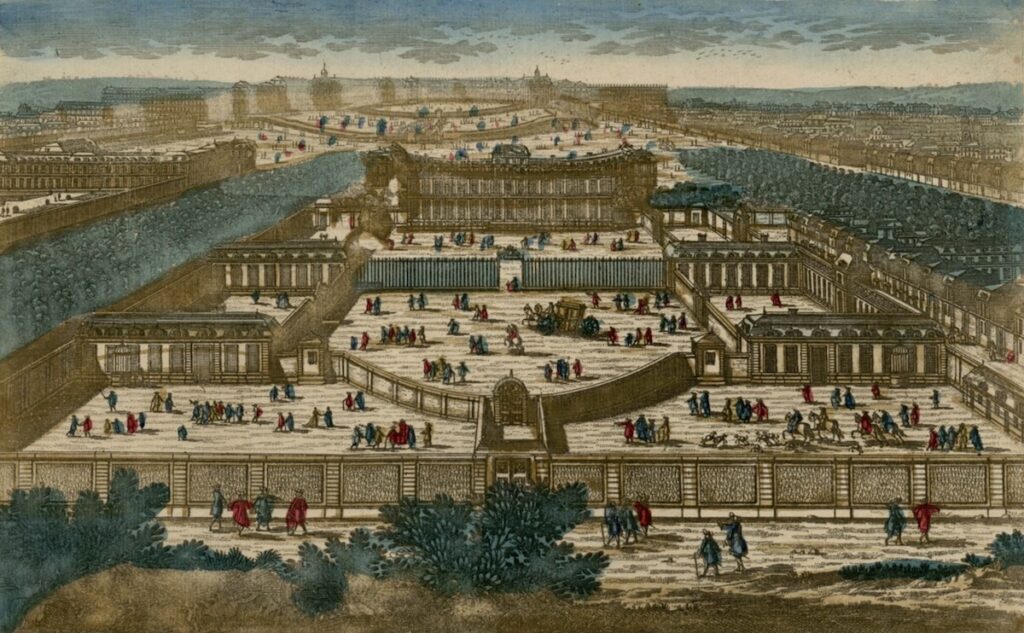
On the screen: an old map of Versailles. And sitting exactly where our building stands — a sprawling royal complex called the Grand Chenil. Louis XIV’s kennels. For his 300 hunting hounds.
Three. Hundred. Dogs.
Right where our Airbnb now stands.

300 Dogs Living Better Than Most French Citizens
If you know anything at all about Louis XIV it’s when he did something, he didn’t do it halfway. So when he moved his court to Versailles in 1682, he didn’t just bring his 300 hunting dogs and stick them in a barn. Oh no no no. He commissioned an entire palatial complex for them.
Just outside the castle gates was the Grand Chenil — a self-contained, highly organized working village for the king’s hunting operations, complete with housing, stables, and service buildings. While the magnificent Écuries across from the palace housed the royal horses, the Grand Chenil was dedicated entirely to the serious business of the hunt.
This wasn’t a kennel in the way we think of them today. This was a sprawling estate featuring:
- Hôtel du Grand Veneur: this was the official residence of the Grand Veneur, or Master of the Hunt — one of the highest offices in the royal household. He oversaw all matters related to hunting, including the kennels and the hunting staff. The Hôtel was a substantial, elegant house within the kennel complex.
- Officers’ lodgings: these were housing units for the various officers and attendants attached to the royal hunt — such as dog handlers (valets de chiens), stablemen, and other personnel who cared for the animals.
- Kennels: the heart of the complex — a series of long, ventilated structures designed for housing hundreds of hounds. They would have included feeding areas, washing zones, and perhaps small yards for exercise.
- Technical buildings: these covered the functional infrastructure needed to sustain such an operation — kitchens for preparing dog food, storage rooms, maintenance workshops, and possibly spaces for veterinary treatment.
(The architectural-history study from Les Annales de l’Histoire de l’Architecture, published on journals.openedition.org, gives the full technical breakdown.)
I’ve toured enough European palaces to know opulence when I see it. But imagining 300 dogs living in this kind of luxury while most French peasants struggled to survive? That’s peak royal excess right there.
The Sun King’s Morning Routine: Dog Biscuits Before Government (?!)
The deeper I dug into Versailles history, the more I became obsessed with the small details and all the strange personal connections to this ancient world. What I find fascinating about Versailles isn’t the wigs, the wars, or even King Louis’ sexy dancing legs — it was his love of animals, but especially dogs.
The kings of Versailles were famously devoted to their dogs.
Within the palace walls, an even more intimate canine world existed.
Most tourists don’t get to go inside the Petit Appartement du Roi, the king’s private retreat, where is was a small chamber known as the Cabinet des Chiens — literally, “the dogs’ room”. It’s the room name, along with the cornice decor recall that Louis XV had his favorite dogs sleep here, reminiscent of Egyptian hieroglyphs.
The very existence of such a room says much about royal priorities. Even in the most formal household in Europe, the king’s dogs had their own elegant corner of the castle.
Now, here’s where history blurs into legend. Some accounts claim that Louis XIV began his mornings not with ministers or ambassadors, but with his dogs — personally feeding them biscuits before attending to the affairs of state. There’s no surviving record of a royal pastry chef assigned to canine confections, but it’s exactly the kind of ritual that feels possible at Versailles.
As I was installing modern amenities in our Airbnb, I couldn’t help thinking about that image. Three centuries ago, a king might have been anxiously ensuring the royal hounds preferred veal over venison biscuits — and here I am, stressing over which coffee maker to buy for our guests.
The irony isn’t lost on me.
The the Revolution Happened
As it does.
The Grand Chenil’s glory days ended when the monarchy fell. These magnificent buildings that once housed the kingdom’s most pampered pooches suddenly seemed… excessive.
Napoleon briefly revived it around 1810 — because even revolutionary emperors love a good hunt — but it didn’t last.
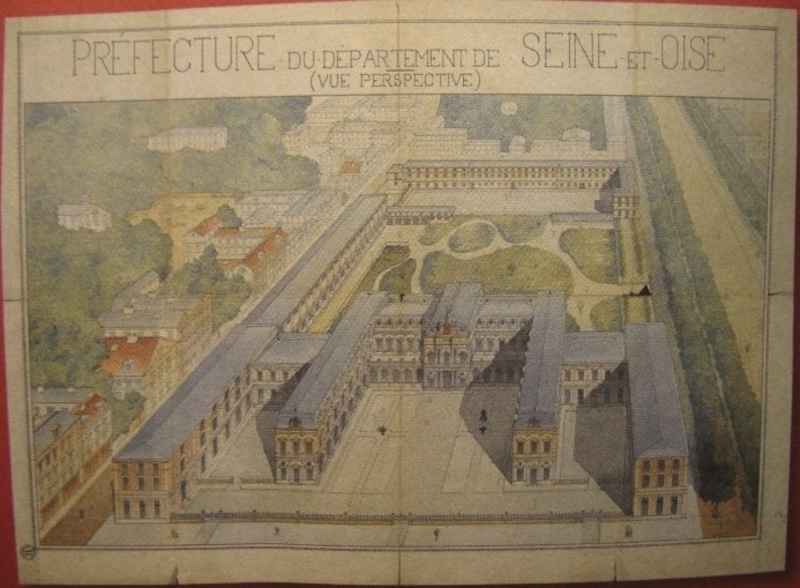
By 1861, the Prefecture of Seine-et-Oise purchased the crumbling kennels for 900,000 francs—roughly $6-7 million in today’s money. tore everything down, and built a government office in its place.
Which eventually came to share a wall with our apartment.
Renovating on Top of History
I’ll be honest: renovating ancient buildings is not without it’s own special challenges, but knowing this history completely changed how I approached our renovation. Every time we uncovered something unexpected—an unusually thick wall, a strange angle in the foundation—I knew we were touching on things with hundreds of years of history.
We couldn’t afford to do a full historical excavation (this was an AirBnB project, not an archaeological dig), but we tried to honor the building’s past. We kept exposed beams where we could. We researched period-appropriate color palettes and went with Marie Antoinette vibes.
Most of our guests never know that they’re sleeping where royal hunting dogs once lived better than nobles.

Why This Story Still Matters
Walking our own mini dachshund, Ringo, past the prefecture building now, I see it differently.
This isn’t just bureaucratic office space. This is where Louis XIV and his team raised and bred hunting champions. This is where centuries of tradition suddenly stopped. This is where power and priorities shifted.
And now? Now it’s where travelers from around the world stay for a few nights, completely unaware of the canine royalty that preceded them.
The transformation from dog palace to government offices to vacation rental captures something essential about how cities evolve. Nothing stays the same. Values change. Priorities shift. Royal kennels become prefectures become AirBnBs.
But the stories remain, if you know where to look.
What Our Guests Don’t Know (Until Now)
I’m seriously considering printing this out and leaving it on the coffee table.
Most guests care about the WiFi password. Whether there’s a good coffee setup. Fair enough.
But for the ones who want more than just a place to sleep — who want a story to bring home from Versailles — this is the spot.

The Next Chapter
The Airbnb has been running for a few years now. Five-star reviews. Happy guests. The occasional comment about the amazing hostess (I’ll allow it).
But sometimes, late at night when the building gets quiet, I swear I can almost hear it — 300 dogs, trainers calling commands, Louis XIV laughing as his favorite hound performs for a biscuit.
Or maybe that’s just the neighbor’s terrier.
Either way, I love what this place has become. A home away from home, built on top of one of the stranger, more wonderful footnotes in Versailles history.
Want to experience this history for yourself? Our AirBnB is available to book, and I promise the accommodations are significantly better than what those 300 hunting dogs enjoyed.
We have WiFi, for starters.

FAQs
u003cstrongu003eWhere were the Royal Kennels in Versailles?u003c/strongu003e
The Grand Chenil was located along Avenue de Paris, Versailles, just outside the palace grounds. Today, the Prefecture of Seine-et-Oise and surrounding buildings (including residential apartments like ours) occupy the site.
u003cstrongu003eWhat is the Grand Chenil in Versailles?u003c/strongu003e
The Grand Chenil was the official Royal Kennels of Versailles, established under Louis XIV to house and train his elite hunting dogs. It was a grand facility that played a crucial role in Versailles dog history before being repurposed in the 19th century.
u003cstrongu003eWhat happened to the Grand Chenil after the fall of the monarchy?u003c/strongu003e
Following the French Revolution, the role of the Grand Chenil diminished as hunting became less central to aristocratic life. By 1861, the site was sold to the Prefecture of Seine-et-Oise, which demolished the kennels and built an administrative government building in its place.
u003cstrongu003eCan visitors see any remains of the Grand Chenil today?u003c/strongu003e
The original structures were demolished in the 1860s, but the location itself carries the history. Walking along Avenue de Paris, you’re literally tracing the steps of royal huntsmen and their legendary hounds.
u003cstrongu003eHow do you know your building is connected to the kennels?u003c/strongu003e
Historical maps, local records, and the building’s location all point to this connection. While we can’t prove our specific apartment was directly part of the original Grand Chenil, we’re definitely on the site of this historic complex.
Want to sleep where the king’s hounds once lived? Book your stay at our historic Versailles apartment.